


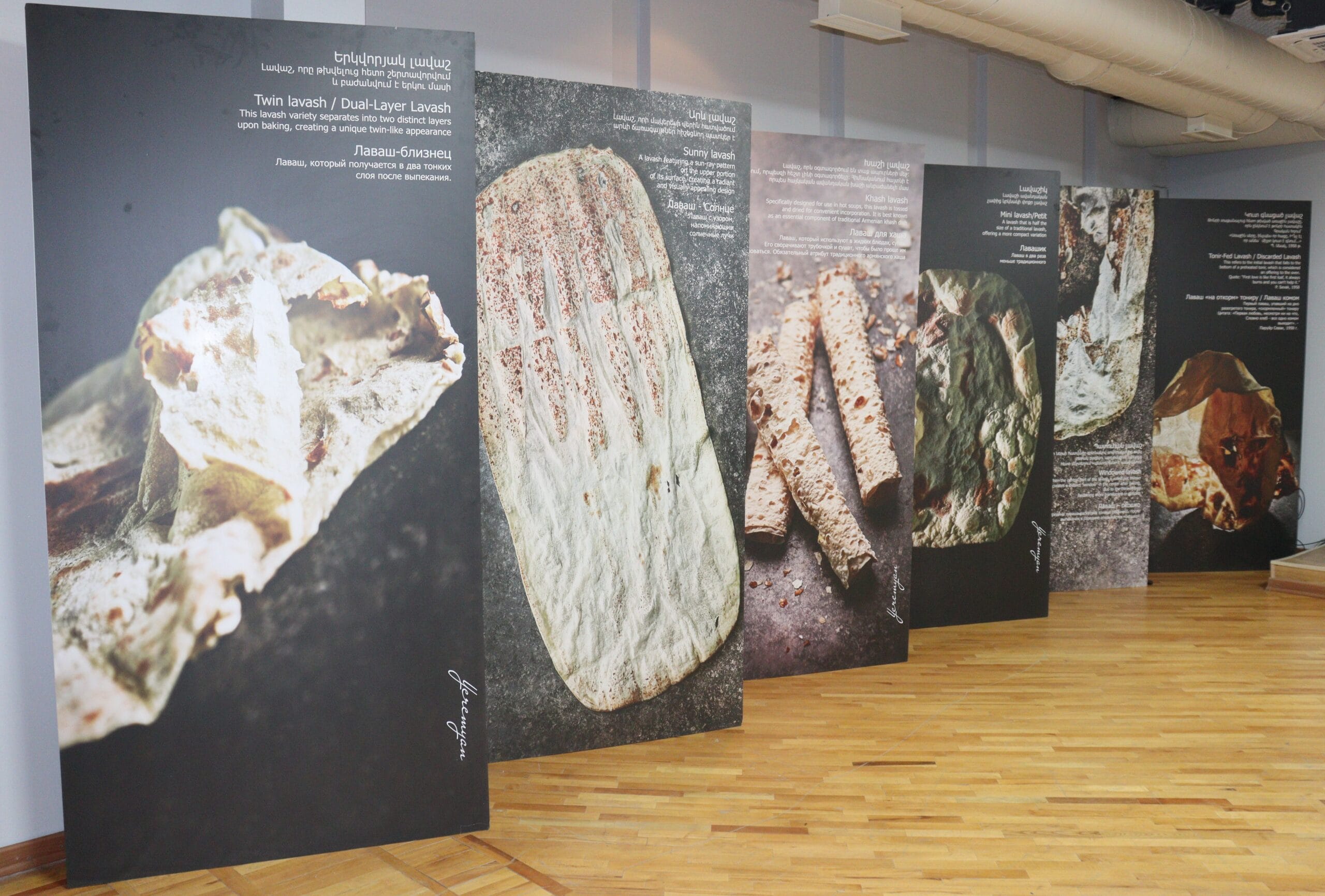


On October 16th, World Bread and Food Day, the opening ceremony of the temporary exhibition “Lavash Portraits: Armenian Bread Photostories” took place at the Museum, through the collaboration of the History Museum of Armenia and Yeremyan Projects.
Opening remarks were given by Arusyak Ghazaryan, Deputy Director for Development of the History Museum of Armenia, who noted that the day is symbolic because it presents yet another opportunity to speak about bread as a symbol of national identity, culture and memory. This exhibition, organized through the collaboration of the Museum and Yeremyan Projects, proves that creative collaboration and joint initiatives can breathe new life into cultural heritage.
Lusine Yeremyan, Yeremyan Projects Deputy General Director and Management Board Member, emphasized in her opening remarks that the exhibition is a major step in the work of publicizing and maintaining Armenian bread culture, as one of the most important parts of Armenian identity. She highlighted the fact that lavash is not just food, but a tradition passed down from generation to generation that binds families together.
Astghik Israelyan, senior researcher in the Ethnography Department of the History Museum of Armenia, gave a talk entitled “The Role of Salt and Bread in Armenian Culture.” She presented the role and significance of bread in the daily life, habits, and traditions of the Armenian people. She also spoke about the national forms of hospitality and the supernatural characteristics ascribed to bread and items tied to it, as well as the various magical functions deriving from it.
The event continued with the performance of ceremonial songs dedicated to bread by the “Akunq” Ethnographic Ensemble.
About 20 unique stories and types of lavash, the goal of which was to once again present visitors with familiar and unfamiliar aspects of lavash. The baker’s mastery and photographer’s skills were intertwined to create a series of types of lavash, each of which has its color, form, and history.
HISTORY MUSEUM OF ARMENIA